Why You Need More Than SEO to Get Found?
GEO optimizes for AI citations while SEO targets rankings. Both matter in 2026. Here is how they differ and how to use them together.
Key Takeaways
- •SEO optimizes for search engine rankings while GEO optimizes for AI-generated answers
- •GEO focuses on being cited as a source rather than being clicked as a result
- •Both disciplines share a foundation of quality content but differ in execution
- •Structured data and clear entity definitions are more important in GEO than in traditional SEO
- •Businesses that master both SEO and GEO will have a significant competitive advantage
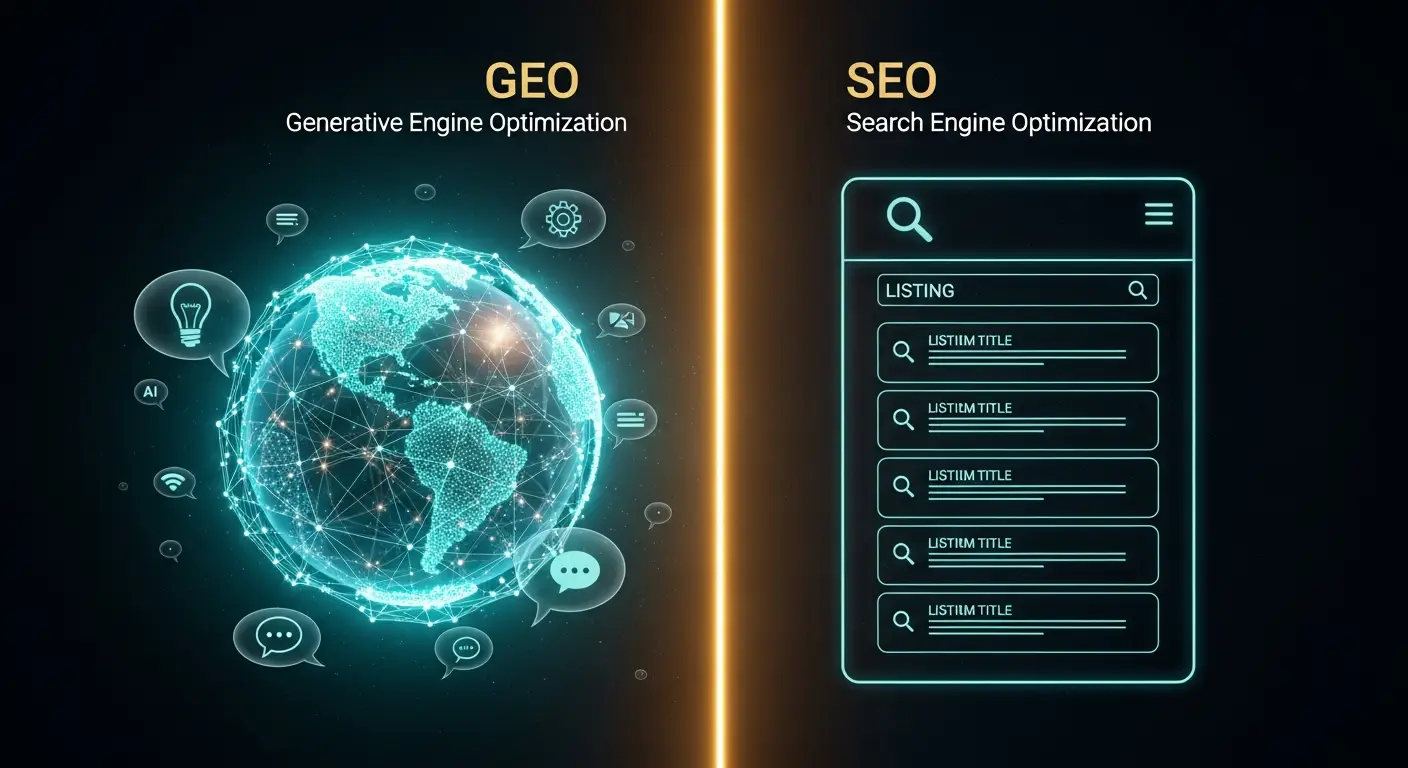
Picture two coffee shops across the street from each other in LoHi. One ranks number one on Google for "best coffee shop LoHi Denver." The other doesn't rank at all on Google but is the shop ChatGPT, Claude, and Perplexity recommend when someone asks for a coffee recommendation near LoHi.
Both are getting customers through search. They're just getting them through completely different systems.
That's the split between SEO and GEO in 2026. One gets you clicks from a search results page. The other gets you cited in an AI-generated answer. And the businesses pulling ahead fastest are the ones doing both.
This divergence is playing out everywhere. A veterinary clinic could have solid SEO with good rankings and decent traffic, yet when you test its visibility in AI chat tools, it's nowhere. Meanwhile, a newer competitor with weaker Google rankings shows up consistently in ChatGPT recommendations because its content and online presence are structured in ways AI models can readily parse and reference.
This post is part of my 2026 Guide to Search Visibility series.
What Is the Difference Between GEO and SEO?
SEO makes your website rank high in search engine results pages. You earn clicks by appearing in Google's list of links.
GEO makes your website get cited when an AI generates an answer. You earn visibility by appearing as a trusted source inside the AI's response.
Both aim to bring customers to your door. They just optimize for fundamentally different systems.
How Traditional SEO Still Works
SEO has been the primary digital marketing channel for over twenty years. The core mechanics remain effective:
- Keyword research to discover what people actually search for
- On-page optimization to structure pages around those terms
- Technical SEO to make your site fast, crawlable, and correctly built
- Backlinks from reputable external sites that vouch for your authority
- Quality content that provides genuine value and keeps people on the page
None of this is obsolete. If you neglect foundational SEO, you're walking away from the largest source of commercial web traffic that exists today.
How GEO Operates Differently
GEO starts from a different question entirely. Instead of asking "how do I rank for this keyword?" it asks "how do I become a source that AI models trust enough to cite?"
Entity precision
AI models organize information around entities: people, businesses, concepts, locations. GEO requires that your business exists as a sharply defined entity across the web. Your name, services, address, credentials, and specializations must be stated consistently and clearly everywhere you appear online. Ambiguity is the enemy. If there's any confusion about what your business does or where it's located, AI models will cite a competitor whose information is cleaner.
Content that machines can quote
AI models process content differently from traditional search crawlers. They're looking for statements they can confidently attribute to a source:
- Direct answers to questions people actually ask
- Factual claims backed by evidence, experience, or credentials
- Clear heading hierarchy with logical flow
- Specific signals of expertise like methodology descriptions, results, and professional background
Citations over clicks
Traditional SEO is about earning clicks. GEO is about earning citations. Your content needs to be the kind an AI model feels confident putting its name behind. That means authoritative, specific, and grounded in real expertise. Fluffy marketing language gives AI nothing usable.
Structured data as a requirement
Schema markup has always helped with SEO, but GEO makes it practically mandatory. AI models lean on structured data to understand what your content covers, who created it, and how reliable it is.
I break this down further in my post on how schema markup helps AI understand your business.
The Overlap Between SEO and GEO
These two disciplines share considerable common ground:
- Both reward genuinely helpful, authoritative content
- Both benefit from strong technical performance in speed, security, and markup
- Both value E E A T (Experience, Expertise, Authoritativeness, Trustworthiness) signals
- Both require consistent effort sustained over months
If you're already doing solid SEO work, you have a head start on GEO. The gap is mainly about becoming more intentional with content structure and entity definition across the web.
How Do GEO and SEO Strategies Differ?
| Factor | SEO | GEO |
|---|---|---|
| Primary goal | Rank in search results | Get cited in AI answers |
| Success metric | Click-through rate | Citation frequency |
| Content style | Keyword-optimized | Entity and fact-optimized |
| Technical focus | Crawlability, speed | Schema, structured data |
| Link strategy | Earn backlinks | Build entity associations |
What This Means for Your Business
You need both channels working. SEO drives direct traffic from traditional search results. GEO builds visibility through AI-generated recommendations and answers. Together they create a search presence that competitors struggle to match.
The businesses that fall behind are the ones with competent traditional SEO who haven't adapted to AI-driven search at all. They still rank for their keywords. But they're missing the growing share of discovery happening through AI Overviews and LLM-powered chat tools.
My Unified Approach
I don't treat SEO and GEO as separate workstreams. The best approach builds strategies that serve both:
- Start with thorough keyword and topic research
- Create content structured to rank in traditional search and get cited by AI
- Implement comprehensive schema markup across the site
- Build topical authority through clusters of interlinked content
- Monitor both rankings and AI citation visibility monthly
The work is more layered than old-school SEO, but the output is stronger and more resilient to algorithm changes on either side.
Mistakes I See When Businesses Discover GEO
The same errors show up repeatedly.
Dropping SEO to chase GEO
Some business owners hear about GEO and decide it replaces everything they were doing before. It doesn't. Traditional search still drives the majority of commercial traffic on the web. GEO adds a layer of visibility. It doesn't substitute for the foundation. Think of it like expanding into a new sales channel. The original one still needs to perform.
Treating GEO as a one-time setup
GEO isn't something you configure once and walk away from. AI models retrain on fresh data regularly. Your entity signals, content freshness, and citation patterns all need ongoing attention. I fold GEO maintenance into monthly content strategies alongside regular on-page SEO updates.
Letting entity information drift
Your business details must be identical across every platform: your website, Google Business Profile, social media accounts, directory listings, and anywhere else you appear. AI models cross-reference multiple sources to verify entity data, and inconsistencies reduce their confidence in referencing you.
Imagine a home cleaning service with three different phone numbers and two different business name formats spread across online profiles. Until those are consolidated, AI tools can't reliably connect the dots and won't recommend the business.
Writing content that reads like a database
Some businesses produce content so heavily optimized for machines that it's painful for humans to read. The content still needs to work for real visitors who land on the page. The best GEO content serves both audiences. Write for people first, then refine the structure for AI consumption.
Auditing Your GEO Readiness
Before building a GEO strategy, you need a clear baseline.
Step 1: Test AI visibility directly
Open ChatGPT, Claude, and Perplexity. Ask each one questions your ideal customers would ask. "Who does the best [your service] in [your area]?" or "What should I look for when hiring a [your service type]?" Note whether your business appears. If it doesn't, you have your starting point.
Step 2: Evaluate entity clarity
Search your business name in Google. Does a Knowledge Panel appear? Is every detail correct? Check your schema markup. Run your structured data through Google's Rich Results Test to confirm it parses without errors.
Step 3: Examine your content structure
Review five of your most important pages. For each one, ask: does this page make clear, specific, attributable statements? Could an AI model pull a fact from this page and cite it with confidence? If your content is mostly opinion without concrete supporting detail, it's not going to perform well in GEO.
Step 4: Count your citation footprint
How many credible third-party sources mention your business? Local citations, press coverage, directory listings, and industry publications all contribute. AI models gauge entity authority partly based on how many independent, trustworthy sources reference you.
Why Timing Matters
Every month without GEO work is a month your competitors could be establishing themselves as the AI's default recommendations. AI models form associations based on accumulated data. Businesses that build strong entity signals and consistent citation patterns now lock in a meaningful head start that becomes harder for latecomers to overcome.
This dynamic plays out in every market. The businesses that optimize for AI citation early become the default recommendations, and competitors who wait find it harder to break in because the AI has already formed its preferences based on the data available.
Adding GEO to your strategy sooner rather than later is a practical business decision. The 2026 search visibility landscape gives a clear advantage to early movers.
Frequently Asked Questions
Is GEO replacing SEO in 2026?
No, GEO supplements SEO rather than replacing it. Traditional search still accounts for the majority of commercial web traffic, and that balance won't flip overnight. What's changing is the growing percentage of discovery happening through AI-generated answers.
The businesses performing best are investing in both disciplines at the same time. GEO expands your search footprint into new channels. It doesn't shift it away from Google.
Do I need to create separate content for SEO and GEO?
Almost never, because well-structured content serves both purposes simultaneously. A blog post that answers a specific question, uses clear headings, includes evidence, and carries proper schema markup ranks well in traditional search and is exactly the kind of content AI models cite.
The difference between SEO content and GEO content is more about structure and markup than about producing entirely separate pieces. I create content once and optimize it for both channels simultaneously.
How do I check if AI models are citing my business?
Manual testing across ChatGPT, Claude, Perplexity, and Google's AI Overviews is the most reliable method right now. No perfect automated tracking tool exists yet, but asking the questions your ideal customers would ask works well.
Do this monthly and record which queries mention your business. Some tools like Perplexity show their source citations explicitly. I also monitor brand impression metrics as an indirect measure of growing AI visibility.
How long does GEO take to show results?
Expect meaningful AI visibility gains within three to six months of consistent effort. GEO timelines vary because AI models update on different schedules. ChatGPT's training data refreshes periodically, not continuously.
But tools like Perplexity and Google's AI Overviews pull from live web data, so improvements to your schema, entity signals, and content structure can show effects within weeks for those platforms.
Relying on SEO alone in 2026 means missing the AI-driven discovery channel that grows larger every quarter. Competitors who master both will occupy the space you left open.
Picture your business ranking on Google and getting cited by ChatGPT, Claude, and Perplexity simultaneously. Two engines of visibility feeding each other, sending a steady stream of customers who already trust what you do.
If you want to understand where your business stands in both traditional and AI-driven search, reach out. I'll run an analysis and show you exactly where the opportunities are.
Want me to help with your SEO?
I help small businesses get found on Google. Let me show you what I can do for yours.
Let's talk