Email Marketing vs Social Media: Which Wins?
Most businesses try to be everywhere and end up effective nowhere. Here is how to choose between email marketing and social media.
Key Takeaways
- •Email marketing consistently delivers higher ROI than social media for businesses
- •You own your email list but you don't own your social media followers
- •Social media builds awareness while email converts awareness into customers
- •Most businesses should prioritize email and use social media selectively
- •The best strategy uses content marketing to drive email signups, then email to drive conversions
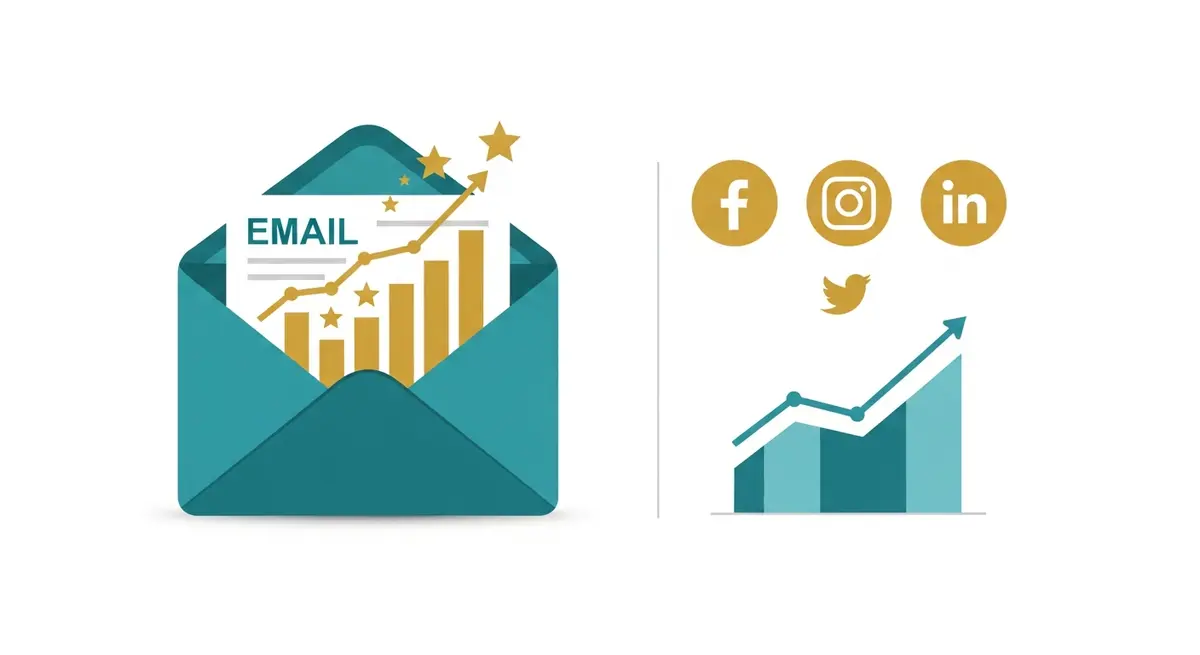
Imagine a local service business with 2,400 Instagram followers. The owner posts consistently for 18 months, tracks every lead source, and discovers that total customers from Instagram can be counted on one hand. Meanwhile, an email list of just 340 people generates over 20 paying customers during the same period. The math is not subtle.
This is not an anti-social media rant. Social media has genuine uses. But when a business owner asks where to spend their limited marketing hours, the answer is almost always email first, social second.
This post is part of my Content & Conversion Strategy series.
The numbers are lopsided
Email ROI
Industry data consistently shows email marketing returning around $36 for every dollar spent. For businesses where the primary investment is time rather than software costs, the effective return is often higher.
Social media ROI
Ask ten business owners what return they get from social media and you'll get ten blank stares. The path from a social post to a paying customer is winding, indirect, and nearly impossible to track for most small operations.
Reach comparison
Average email open rates hover around 20 to 25 percent. Average organic reach on Facebook sits below 5 percent of your followers. Instagram organic reach is roughly 9 percent and shrinking.
That means roughly one in four people on your email list sees your message. Fewer than one in 20 see your social post. When time is limited, those ratios should drive your decision.
Why email works better for businesses
Ownership
Your email list belongs to you. You can export it, move platforms, and reach your subscribers regardless of what any tech company decides to do.
Social media followers belong to the platform. When Facebook throttles organic reach (which it has repeatedly), when Instagram changes its algorithm (which happens constantly), or when a platform faces regulatory challenges, you lose access to the audience you spent months building. You control none of those decisions.
Consider a business that built its client base almost entirely through Facebook. When a combination of algorithm changes drops average post reach from 800 people to under 100 overnight, years of audience-building effort evaporate. An email list would have been completely unaffected.
Email converts directly
When someone gives you their email address, they're explicitly saying "I want to hear from you." That's a fundamentally different signal than someone tapping "follow" while scrolling before bed.
The conversion path is clean and direct:
- Visitor finds your website through SEO
- They sign up for your list in exchange for something useful
- You nurture them with genuinely helpful emails
- They reach out when they're ready to buy
Automation makes it scalable
Build a welcome sequence once, and it runs forever. Every new subscriber gets your introduction, your best content, and a clear next step without you doing anything manually.
Social media is an always-on treadmill. Skip a day and your visibility drops. Skip a week and the algorithm buries you. Email doesn't punish you for taking a vacation.
Where social media earns its place
I'm not saying delete all your accounts. Social media does specific things well:
Awareness
Social puts you in front of people who've never heard of you. It's the top of the funnel. It introduces. It doesn't close.
Credibility signals
An active social presence with genuine engagement tells prospective customers you're a real, operating business. It functions as a trust signal, similar to reviews.
Local community connection
For businesses built on local interaction (restaurants, event spaces, boutiques), social media fosters authentic neighborhood connection. A coffee shop posting about their seasonal menu creates community in a way email can't quite replicate.
Platform fit varies by business
- Instagram: Visual businesses (photographers, florists, interior designers)
- LinkedIn: B2B services (consulting, commercial cleaning, IT services)
- YouTube: Anything requiring demonstration or explanation
- Google Business Profile: Every local business, period (this counts as social too)
How I'd allocate your time
For most Denver businesses, here's the priority order I recommend:
1. Build your email list (primary focus)
Your website's number one job, after explaining what you do, is capturing email addresses. Offer something people genuinely want:
- A free guide or checklist relevant to their situation
- A consultation or audit at no cost
- Early access, insider tips, or special pricing
Every blog post should include at least one email signup opportunity.
2. Send regular emails (primary focus)
One to two emails per month hits the sweet spot for most businesses. Share useful content, relevant updates, occasional offers. Provide genuine value in every single send. Don't pitch in every email.
A content calendar that coordinates your blog posts and email newsletters keeps everything efficient.
3. Post to Google Business Profile (secondary)
GBP posts directly influence local search visibility. It's the one social-type platform with a clear, measurable SEO benefit.
4. Pick one social platform (secondary)
Choose the one where your customers actually spend time. Do it consistently and do it well. One strong platform beats five neglected ones.
5. Repurpose everything (efficiency)
Blog posts become email content. Emails spark social posts. Social engagement generates blog topic ideas. One idea feeds multiple channels with minimal extra effort.
The trap I see constantly
Business owners spending two hours daily on social media and zero minutes on their email list. They're investing their most valuable resource (time) into the channel with the lowest measurable return.
If you have one hour per week for marketing beyond your core work, here's how I'd split it:
- Write one blog post per month (30 minutes per week toward it)
- Send one email per month to your list (15 minutes per week)
- Post to your Google Business Profile (15 minutes per week)
That simple system, executed consistently, will produce more trackable leads than daily Instagram posting.
Starting an email list from zero
Everyone starts with an empty list. The process is the same regardless of your industry.
Create something worth trading an email for
"Subscribe to our newsletter" generates almost no signups. People don't want another newsletter. They want a specific thing that solves a specific problem.
Lead magnets that work for service businesses:
- A checklist that simplifies something complex ("Complete Home Inspection Checklist: 47 Things to Check Before Closing")
- A pricing guide that answers the question everyone has but nobody publishes ("What Does a Bathroom Remodel Actually Cost in Denver?")
- A short video walkthrough that teaches something practical
The key: offer what your ideal customer actually wants, not what you think they should want.
Place signup forms where people see them
Three placements minimum:
- Header or hero area of your homepage, visible immediately on arrival
- Within blog content, after the first major section where engagement peaks
- Exit intent popup, triggered when someone moves their cursor toward closing the tab
Reference the specific lead magnet in each placement. "Get the free pricing guide" converts far better than "join my list."
Build a welcome sequence
When someone subscribes, a sequence of 3 to 5 emails should automatically send over the next two weeks. This sequence introduces you, delivers what you promised, shares your most helpful content, and makes a soft offer. Welcome sequences convert at 5 to 10 times the rate of regular emails because the subscriber's interest is at its peak.
Measuring what email actually produces
Email measurement is far cleaner than social media tracking.
Open rate
Industry average: 20 to 25 percent. Below 15 percent means your subject lines need work or your list needs cleaning. Above 30 percent means you're resonating.
Click-through rate
This tells you whether your content compels action. Average is 2 to 3 percent. Highly targeted, well-maintained lists can sustain 8 to 12 percent.
Unsubscribe rate
Some unsubscribes per send are normal and healthy. Your list is self-filtering. If more than 1 percent unsubscribe from a single email, revisit your content or frequency.
Revenue per email
For businesses tracking conversions, divide revenue attributable to email by the number of emails sent. This single number shows you exactly what your email program is worth. A single well-timed email can generate more revenue than three months of social media posting.
Email mistakes to avoid
Sending too frequently without value
If you promised monthly emails and start sending weekly promotions, trust evaporates fast. Respect the frequency people signed up for.
Ignoring mobile formatting
Over 60 percent of emails get opened on phones. If your template breaks on a small screen, most of your audience sees a mess. Single-column layouts, large readable text, and obvious tap-friendly buttons.
Treating everyone the same
The same email going to every subscriber ignores that different people have different needs. Even basic segmentation (prospects versus current customers) dramatically improves both engagement and relevance.
Frequently asked questions
How often should a business send marketing emails?
One to two emails per month works for most businesses. That frequency is enough to stay in someone's awareness without becoming annoying.
Consistency matters more than volume. A reliable monthly email builds more trust than a burst of three messages in one week followed by six weeks of silence.
What is the best email marketing platform for businesses?
Mailchimp and ConvertKit are both solid, affordable options that work well for getting started. They have respectable automation features and don't require technical expertise.
The platform matters less than actually using it. Pick one and start sending.
Is it worth buying an email list for my business?
Never buy an email list. Purchased lists violate anti-spam laws, spike your bounce rates, generate spam complaints, and destroy your sender reputation.
Every subscriber should have opted in deliberately. A list of 200 people who genuinely want to hear from you will outperform a purchased list of 10,000 strangers every time.
How do I write marketing emails that people actually open?
Subject lines determine open rates, so keep them under 50 characters and create genuine curiosity without resorting to clickbait. Use the recipient's name when possible.
The body should deliver on whatever the subject line promised, provide real value, and include a single clear call to action. Write like you're emailing one person, not broadcasting to a crowd.
If you want help building this system for your business, let's talk.
The core point
Email beats social media for conversion, ROI, and long-term sustainability. Social media has a role, but for businesses with limited time, email should come first.
Every month you spend chasing social media engagement instead of building your email list, you are investing in an audience you do not own and cannot reliably reach.
Imagine sending one email per month to a list of people who actually want to hear from you and watching it generate more leads than three months of daily social posting.
Your website captures addresses. Email converts subscribers into customers. SEO drives people to your website. It's a connected system, not a pile of disconnected tactics.
Want me to help with your SEO?
I help small businesses get found on Google. Let me show you what I can do for yours.
Let's talk