How to Optimize for Alexa, Siri, and Google
Millions of people ask smart speakers questions every day. Here's how I optimize content so it's the answer Alexa, Siri, or Google Home reads back.
Key Takeaways
- •Smart speakers provide a single answer, so being
- •Voice answers must be concise (under 30 seconds when spoken aloud)
- •Local businesses have a significant advantage for "near me" voice queries
- •Google Business Profile optimization is critical for Google Home and Google Assistant
- •Speakable schema markup explicitly tells search engines which content works as a voice response
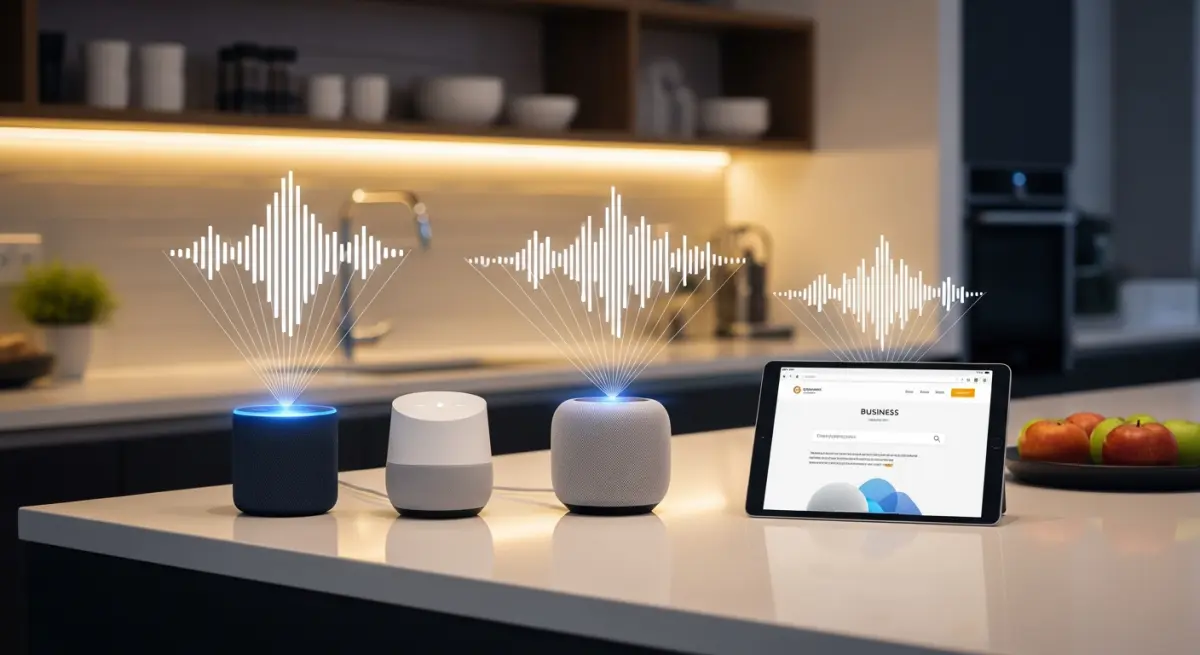
Think about how many people in your life never open a browser anymore. They just talk to the Echo in the kitchen. "Alexa, find a pizza place that delivers." "Alexa, what's the weather?" Now ask yourself: can people find your business that way?
For most businesses, the answer is no. Not yet. But the fix is straightforward once you understand how these platforms work.
Smart home assistants operate on a winner-take-all model. When somebody asks Google Home "who does carpet cleaning near me?" the speaker reads back exactly one answer. Not a list of ten blue links. Not three options. One. You are either the answer, or you are invisible for that query.
This post is part of my Conversational SEO guide series.
Where Each Assistant Gets Its Answers
Each major platform pulls from different data pools, so you need a slightly different approach for each.
Google Home and Google Assistant
Google Home leans heavily on featured snippets, the Knowledge Graph, and Google Business Profile data. If you are already winning featured snippets in traditional Google search results, there is a good chance Google Home is reading your content aloud too. The overlap between position zero wins and voice answer selection is significant.
Amazon Alexa
Alexa pulls primarily from Bing search results along with content partnerships and its own Skills marketplace. This means Bing optimization matters if you want Alexa to reference your business. Most business owners completely ignore Bing, which actually creates an opening.
Apple Siri
Siri blends Apple Maps data, Yelp listings, and web results. Apple Business Connect, which functions like Apple's version of Google Business Profile, feeds directly into what Siri recommends for local searches.
Crafting Content That Gets Read Aloud
Keep it under 30 seconds
A smart speaker answer needs to be comprehensible in about 25 to 30 seconds of spoken audio. That translates to roughly 60 to 80 words. The response must be complete, immediately understandable, and tight enough that a listener grasps it without asking for a repeat.
I test this by literally reading my content blocks aloud and timing them. If a paragraph runs over 30 seconds, I trim.
Make it sound like speech, not writing
Pull up any answer block you have written and read it out loud. If it sounds like something from a legal brief or a graduate thesis, it will not work as a voice response.
Consider the difference. "The optimization of local search positioning encompasses profile completion, review acquisition, and citation consistency." Nobody talks like that. Compare with: "The three biggest things that affect your local search ranking are your Google profile, your reviews, and whether your business info is the same everywhere online." The second version is what a speaker can actually deliver naturally.
Lead with the answer
Use the inverted pyramid structure. Smart assistants extract the first one or two sentences from a content block. Those sentences need to deliver a standalone, complete answer before any supporting detail appears.
Why Local Businesses Have a Natural Edge
Most voice queries with local intent follow a handful of predictable patterns:
- "Find a [service] near me"
- "What's the best [business type] in [location]?"
- "Who does [service] in [area]?"
Local service businesses are inherently positioned to answer these because their content already carries geographic signals. A national brand answering "who does deck staining in Lakewood?" has a hard time competing with a Lakewood contractor whose site naturally references the neighborhoods they serve.
Google Business Profile as the primary data source
For Google Home and Google Assistant, your Google Business Profile is the main source for most local voice queries. Make sure every field is filled out. Choose specific, accurate categories rather than the broadest available option. Write a business description that plainly states what you do and where you operate. Keep hours current. Maintain a consistent flow of recent positive reviews.
Apple Business Connect for Siri
Claim your listing on Apple Business Connect. Most businesses skip this entirely, which means less competition for anyone who takes a few minutes to register. This directly influences what Siri recommends when someone asks for local services on their iPhone or HomePod.
Bing Places for Alexa
Give your Bing Places listing the same attention you give Google Business Profile. Alexa relies on Bing for a large share of its local answers, and the lower competition on Bing means even basic optimization can produce results quickly.
Technical Formatting for Voice Extraction
Build speakable content blocks
Write specific sections of your pages designed to function as spoken answers:
- 60 to 80 words maximum
- Self-contained and complete
- Natural spoken language
- Factually specific
Implement Speakable schema markup
Google supports Speakable schema that explicitly flags which parts of your content are suitable for text-to-speech delivery:
{
  "@type": "WebPage",
  "speakable": {
    "@type": "SpeakableSpecification",
    "cssSelector": [".voice answer"]
  }
}
This signals to Google that a specific paragraph was designed to be read aloud as a voice answer.
Build voice-ready FAQs
FAQ sections are the most effective format for voice search. Each question-and-answer pair is a standalone candidate for voice delivery. The question maps directly to what someone asks their speaker, and the answer is already formatted as a discrete response.
Query Categories That Drive Smart Speaker Usage
Navigational queries
"Call [business name]" or "Navigate to [business name]." These need accurate listings with correct phone numbers and addresses. A wrong phone number means a lost customer and you will never know it happened.
Informational queries
"What is a home inspection?" or "How often should I detail my car?" These need clear, concise educational content on your website.
Transactional queries
"Find a florist near me" or "Who does event planning in Denver?" These depend on optimized local listings combined with strong review profiles.
Follow-up queries
"What are their reviews like?" or "How much do they charge?" These require comprehensive business information available across all platforms.
Winning on Each Platform
Google Home
Google Home draws from the same ranking systems as Google Search. Winning here is essentially about capturing featured snippets and position zero results.
I pull exact questions from Google's People Also Ask boxes and write content that answers them in the opening paragraph. The long-tail question targeting approach for text search applies directly to voice.
Google Home prefers paragraph answers of 40 to 60 words or short numbered lists of 3 to 5 items. I format content so Google can extract a clean answer without parsing complicated sentence structures.
The highest-value voice queries blend location with information. "How much does a home inspection cost in Colorado?" or "What should I look for in a Denver florist?" Local businesses hold an advantage over national competitors for these hybrid queries.
Alexa
Alexa leans on Bing, so Bing SEO drives Alexa visibility. The key steps are registering and verifying through Bing Places for Business, submitting your sitemap in Bing Webmaster Tools, and understanding Bing's slight preference for social signals.
Alexa also pulls from Yelp for local recommendations. A strong Yelp profile with recent reviews directly impacts what Alexa tells users.
Siri
Siri is the least transparent about its ranking factors, but the primary levers I have identified include Apple Business Connect for local results, Yelp reviews and ratings for local recommendations, website accessibility (Apple emphasizes well-structured, accessible sites), and Safari browsing data combined with Apple Maps.
Preparing for Multi-Step Voice Conversations
Smart assistants handle conversational follow-ups better every year. A user might say "find a pet groomer near me," follow up with "which one has the best reviews?" and then say "call them."
Complete every data field. When a follow-up question like "what are their hours?" or "do they offer walk-in appointments?" comes up, the assistant pulls from your business listings. Missing information means the assistant moves to a competitor who has the answer.
Encourage detailed reviews. When someone asks "what do people say about them?" the assistant reads from review content. Reviews that mention specific services and outcomes provide richer answers. My post on asking for reviews covers how to encourage reviews that naturally include useful details.
Make pricing accessible. "How much do they charge?" is among the most common follow-up voice queries. If your pricing ranges are clearly stated on your website and listings, you stay in the conversation.
Maintain NAP consistency. Name, address, and phone number must be identical across every platform. Smart assistants cross-reference multiple sources, and inconsistencies can get your business dropped from voice results.
Tracking Voice Search Performance
Voice search is harder to measure than traditional search because most voice interactions do not appear in standard analytics. But you can monitor useful proxies:
- Featured snippet wins serve as a strong indicator of voice answer wins
- Rankings for "near me" and question-format keywords correlate with voice queries
- Phone calls from Google Business Profile are often triggered by voice search
- Search Console impressions for long-tail conversational queries suggest voice activity
What Comes Next for Smart Assistant Optimization
Multimodal responses. Smart displays like Echo Show and Google Nest Hub combine spoken answers with visual content. Your images, videos, and structured data will increasingly shape how your business shows up in voice results.
Proactive recommendations. Assistants are beginning to make unprompted suggestions based on user routines and schedules. Businesses with complete listings and strong reviews are better positioned for these unsolicited mentions.
AI model integration. As AI models get embedded into smart assistants (Gemini in Google Home, for example), optimization strategies increasingly overlap with GEO. Clear answers, strong authority signals, and comprehensive business information serve well regardless of how the underlying technology evolves.
Voice search through smart assistants keeps growing, especially for local service businesses. The optimization work overlaps substantially with conversational SEO and zero-click visibility, so the effort serves multiple channels at once.
Focus on concise natural-language answers, optimized business listings, and strong review profiles. Those fundamentals work across all three major platforms.
Every time someone asks their speaker for a recommendation and you are not the answer, a competitor gets that customer. Smart speakers read back one result, and second place is the same as invisible.
Now picture your business being the name Alexa reads aloud, the one Google Home recommends, the one Siri pulls up when someone asks for help. That consistent presence turns voice queries into phone calls, bookings, and new clients on autopilot.
Want to optimize for voice search? Let's make your business the answer.
Frequently asked questions
What percentage of Google searches are voice searches in 2026?
Voice search accounts for roughly 30 to 35% of all searches, with that share climbing to nearly half for local "near me" queries. The growth has been steady rather than sudden, but for local service businesses the volume is meaningful enough that skipping voice optimization means handing opportunities to competitors who are paying attention.
Do I need to create separate content for voice search?
No, voice optimization strategies simultaneously improve your traditional SEO, so separate content is unnecessary. The strategies that work for voice, clear answers, natural language, structured data, comprehensive business listings, simultaneously improve your traditional on-page SEO.
The best approach is optimizing existing content to sound natural when spoken aloud. That improvement lifts performance across every search channel without requiring separate pages.
Should I optimize for Google Home, Alexa, or Siri first?
Start with Google Home and Google Assistant because Google dominates local search and the optimization overlaps directly with your existing SEO efforts. Siri is second priority due to Apple's enormous mobile device market share, since plenty of Siri queries happen on iPhones rather than home speakers.
Alexa is third for most local businesses, though it becomes more relevant if your customer base leans toward the Amazon ecosystem.
Do Google reviews affect voice search rankings?
Yes, reviews are one of the strongest signals for voice search, particularly for local queries where assistants weigh volume, recency, and sentiment. When someone asks "who is the best event planner in Denver?" the assistant weighs review volume, recency, and average rating.
But it goes further. Review sentiment matters too. Detailed reviews that mention specific services and positive outcomes carry more weight than generic five-star ratings. A business with 50 detailed reviews can beat one with 200 vague ratings in voice search selection.
Want me to help with your SEO?
I help small businesses get found on Google. Let me show you what I can do for yours.
Let's talk