How Much Should a New Business Spend on Marketing?
Marketing feels expensive when you're not sure what works. I share how Denver businesses should think about their marketing budget to maximize.
Key Takeaways
- •Most businesses should invest 5 to 10 percent of revenue in marketing
- •Start with the highest-ROI channels and expand as results prove the investment
- •SEO has the highest long-term ROI but requires patience during the first three to six months
- •Free tools like Google Business Profile and Search Console should be maximized before spending on paid channels
- •Track every dollar spent against leads and revenue generated to make informed budget decisions
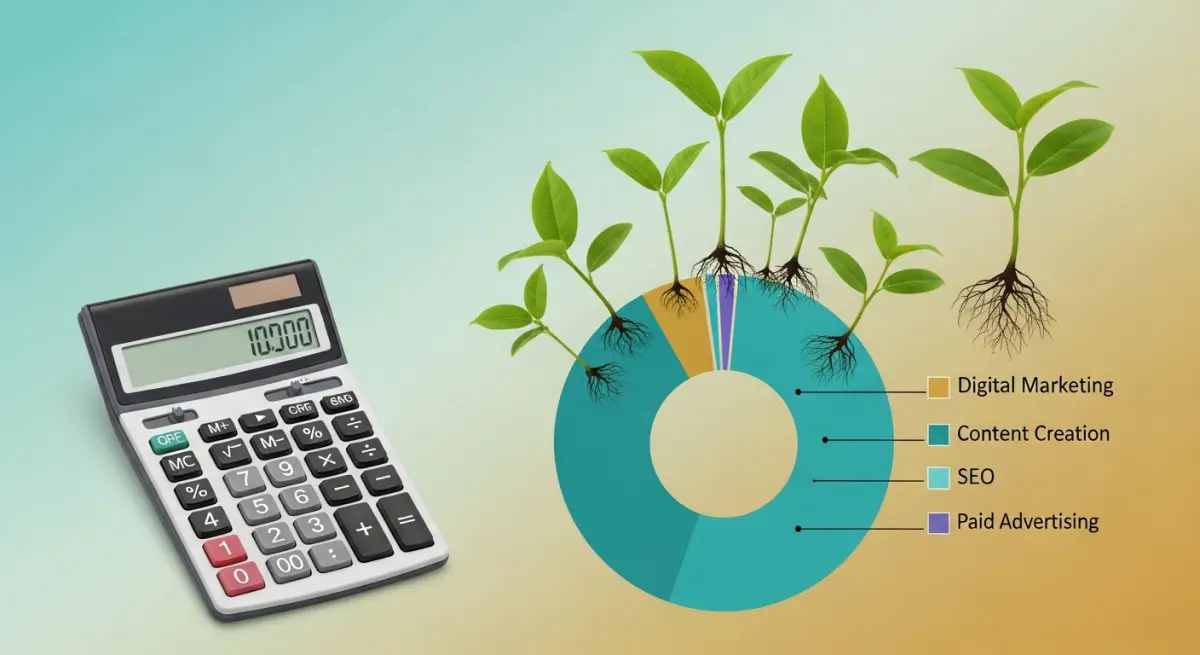
What would you spend on marketing if you knew exactly which dollar produced which customer? That is the question every business should be asking. And the honest answer is that you can get surprisingly far without spending much, if you spend in the right order.
This post is part of my Marketing Playbook series.
The baseline numbers
The general rule floating around is 5 to 10 percent of gross revenue. A business earning $250,000 annually would allocate $12,500 to $25,000 per year. Monthly, that's roughly $1,000 to $2,100.
If you're in aggressive growth mode, push toward 10 to 15 percent. If you've already established a solid market position and you're maintaining, 5 to 7 percent usually holds.
But percentages only tell part of the story. Where the money goes matters far more than the total amount.
Spend nothing before spending smart
Free tools that outperform paid ones
Before writing a single check, exhaust every free resource available:
- Google Business Profile: Full setup, weekly posts, regular photo uploads. Completely free.
- Google Search Console: Shows you exactly what people search before finding your site. Free.
- Google Analytics: Tracks everything happening on your website. Free.
- Review generation: Asking happy customers to leave a Google review. Free.
- Social media presence: Basic profiles on one or two relevant platforms. Free.
Consider a business spending $1,200 a month on Instagram ads that has never claimed its Google Business Profile. Pausing those ads, optimizing the GBP, and giving it 60 days could easily produce more inquiries from Google Maps than the ads ever did. Sometimes the best marketing move is claiming what is already yours.
Your website (first dollar you spend)
Every marketing channel sends people to your website. If the site doesn't work properly, every dollar going into other channels loses value.
Priority website investments:
- Professional, clean design with clear messaging
- Mobile optimization (over half your visitors are on phones)
- Speed optimization (slow pages lose visitors)
- On page SEO fundamentals
A quality business website costs $2,000 to $10,000 depending on complexity. It's a one-time investment that returns value for years. Skimping here is false economy.
SEO (second dollar you spend)
SEO produces the best long-term returns for local service businesses. Monthly services typically run $500 to $2,000.
The catch: results take time. Three to six months before organic traffic starts climbing meaningfully. You're planting seeds now that produce fruit next quarter. But once those rankings take hold, leads flow without ongoing ad spend. Industry benchmarks show well-executed local SEO campaigns regularly generating five to ten times the annual investment in revenue from organic search.
Content marketing (third dollar)
Blog content fuels SEO and positions you as the go-to expert in your space. If you write it yourself, the cost is purely time. Hiring a skilled writer runs $200 to $500 per post.
I suggest one to two posts per month for most businesses. That's $200 to $1,000 monthly if you outsource. Each post becomes a permanent asset that drives traffic for years.
Paid advertising (only after the foundation holds)
Google Ads and social ads work well when your website reliably converts visitors. Running paid traffic to a site that confuses people or loads slowly is like paying to fill a bucket with holes.
When you're ready, start with $500 to $1,000 per month. Measure aggressively. Scale only what proves profitable.
Understanding what a customer is worth
Customer lifetime value
Before budgeting anything, calculate what a single customer is actually worth to your business:
Average project value multiplied by repeat purchases multiplied by how long they stay
A residential electrician whose average job runs $1,500 and whose typical customer calls back three times over five years has a customer lifetime value of $4,500.
Maximum acquisition cost
How much can you afford to spend landing one customer? A safe benchmark is 10 to 20 percent of lifetime value.
For that $4,500 electrician customer, spending $450 to $900 to acquire them makes financial sense. Knowing this number prevents both overspending and underspending.
Track it all
Every dollar should connect to a measurable outcome. Setting up conversion tracking, call tracking, and lead attribution means you always know which channel produced which lead.
If a channel is not delivering within a reasonable timeframe, move the budget. No guessing.
The most expensive mistake is inconsistency
Dropping $500 into SEO for two months, seeing no dramatic change, switching to Google Ads for a month, then abandoning that too. I see this pattern constantly. It produces nothing except wasted money and frustration.
Marketing compounds. The businesses that see real returns commit to a channel for six months minimum, fund it at a reasonable level, and measure the trajectory. Then they make decisions based on data instead of impatience.
Consistency builds momentum. Inconsistency resets the clock every time.
Sample budgets
Getting started: $500 to $1,000 per month
- SEO and Google Business Profile optimization
- Write your own blog content
- Reinvest as revenue increases
This works for businesses under $150,000 in annual revenue that are willing to do some of the work themselves.
Growing: $1,000 to $2,500 per month
- Professional SEO services
- One to two professionally written blog posts per month
- Review management
- Small-scale paid advertising experiments
This fits businesses between $150,000 and $400,000 annual revenue that want to accelerate.
Established: $2,500 to $5,000 per month
- Full SEO and content strategy
- Paid advertising on proven channels
- Reputation management
- Conversion optimization and testing
For businesses above $400,000 that are ready to dominate their local market.
When to increase your budget
There are four signals that indicate it is time to ramp up spending.
Your lead flow is predictable
When your current marketing produces a consistent, trackable stream of inquiries, you have the data to scale intelligently. You know your cost per lead, your conversion rate, and what adding budget should produce.
You're turning work away
If you're booked solid and declining good prospects regularly, it's time to invest in both capacity and marketing simultaneously. Growing demand without the ability to fulfill it just creates frustrated customers.
Your acquisition cost is well below maximum
If you can afford $800 to acquire a customer and you're acquiring at $250, that gap is growth opportunity. Push harder on the channels producing those economics.
A channel works but isn't maxed out
Sometimes a business gets strong results from SEO but only targets a handful of keywords. Or their Google Business Profile drives consistent leads but they barely post. When something proven is underutilized, adding budget there is the lowest-risk growth play available.
Budget mistakes I see repeatedly
Chasing whatever's new
Every few months, a new platform or tactic promises breakthrough results. Business owners redirect budget from what's actually working and end up with two weak channels instead of one strong one. Stick with the fundamentals until they're truly maxed out.
Paying for ads before fixing the website
Imagine spending $2,500 monthly on Google Ads while sending that traffic to a site that takes nine seconds to load and has no clear way to request a quote. Fix your website performance and conversion path first.
Skipping free channels entirely
Some owners jump straight to paid advertising because it feels faster. But Google Business Profile optimization, review generation, and basic on-page SEO are free and frequently outperform ads. Max out free before paying for traffic.
Forgetting content maintenance
Blog posts and web pages aren't permanent. Set aside 10 to 15 percent of your marketing budget for content refreshes, site updates, and ongoing optimization. Stale content loses rankings, which means losing leads you already earned.
Planning a 12-month budget roadmap
Rather than picking a flat monthly number and never revisiting it, the best approach is a 12-month plan with distinct phases.
Months 1 through 3: Foundation
Higher investment in one-time costs. Website improvements, initial SEO audit, Google Business Profile optimization, analytics setup. Monthly spend peaks here but drops once the infrastructure is in place.
Months 4 through 6: Building
Budget shifts toward ongoing work. Monthly SEO, content creation, review generation. Consistent effort starts building real momentum. Track early indicators like search impressions and keyword movements.
Months 7 through 9: Refining
Now you have enough data to make smart decisions. Double down on channels producing leads. Scale back what isn't performing. This is also when paid advertising makes sense for many businesses, because the organic foundation can handle it.
Months 10 through 12: Scaling
Increase investment in proven channels. Expand keyword targets. Add new content clusters. Explore multi-platform discovery. This is where compounding becomes visible, and the investment starts feeling obvious.
Frequently asked questions
How much should a startup spend on marketing with no revenue?
Keep costs as close to zero as possible and maximize free tools until consistent revenue arrives. Get your Google Business Profile fully optimized, target your primary keywords with basic on page SEO, and ask every customer for a review.
Once consistent revenue arrives, allocate 10 to 15 percent toward growth marketing. The goal in early stages is building a foundation, not spending aggressively.
Is SEO worth the cost for a small local business?
For local service businesses, SEO consistently delivers the highest long-term return of any marketing channel. The initial investment takes three to six months to show results, but once rankings take hold, leads keep flowing without ongoing ad spend.
Industry data consistently shows well-executed local SEO campaigns generating five to ten times the investment in annual revenue from organic search alone.
Should I hire a marketing agency or do it myself?
It depends on your available time and how comfortable you are learning new skills. If you can dedicate a few hours per week and you're willing to pick things up, you can handle the basics: Google Business Profile management, straightforward blog posts, social media.
For technical SEO, website development, and strategic content planning, professional help typically produces faster and stronger results. I cover this decision in detail in my post on DIY marketing versus hiring an agency.
How do I know if my marketing spend is working?
Track three numbers: cost per lead, cost per customer acquisition, and customer lifetime value. If your acquisition cost sits below your maximum acceptable threshold and trends downward over time, your budget is working.
If you can't track these numbers, that's the first problem to solve. Set up proper analytics and conversion tracking before increasing spend.
Where this all leads
Marketing is an investment with trackable returns, not an expense to minimize. The right budget, directed at the right channels in the right order, produces growth you can see in the numbers.
Start with what you can sustain for six months. Prioritize high-ROI channels. Track everything. Scale what works.
Without a clear budget strategy, money leaks into channels that produce nothing while the high-return opportunities sit untouched.
Imagine knowing exactly where every marketing dollar goes and watching each one produce measurable returns that fund the next round of growth.
If you want help building a marketing budget that fits your business, let's talk. I'll help you place every dollar where it generates the most return.
Want me to help with your SEO?
I help small businesses get found on Google. Let me show you what I can do for yours.
Let's talk