How Strangers on Google Become Paying Clients
Every customer goes through a journey before hiring you. I map out the stages and show you how to meet potential customers at each step with the right.
Key Takeaways
- •Every customer goes through awareness, consideration, and decision stages before buying
- •Most marketing failures happen because the message doesn't match the customer's current stage
- •Your website and content should address each stage of the journey
- •The journey doesn't end at purchase, since retention and referral are where long-term value lives
- •Mapping your specific customer journey reveals exactly where you're losing potential clients
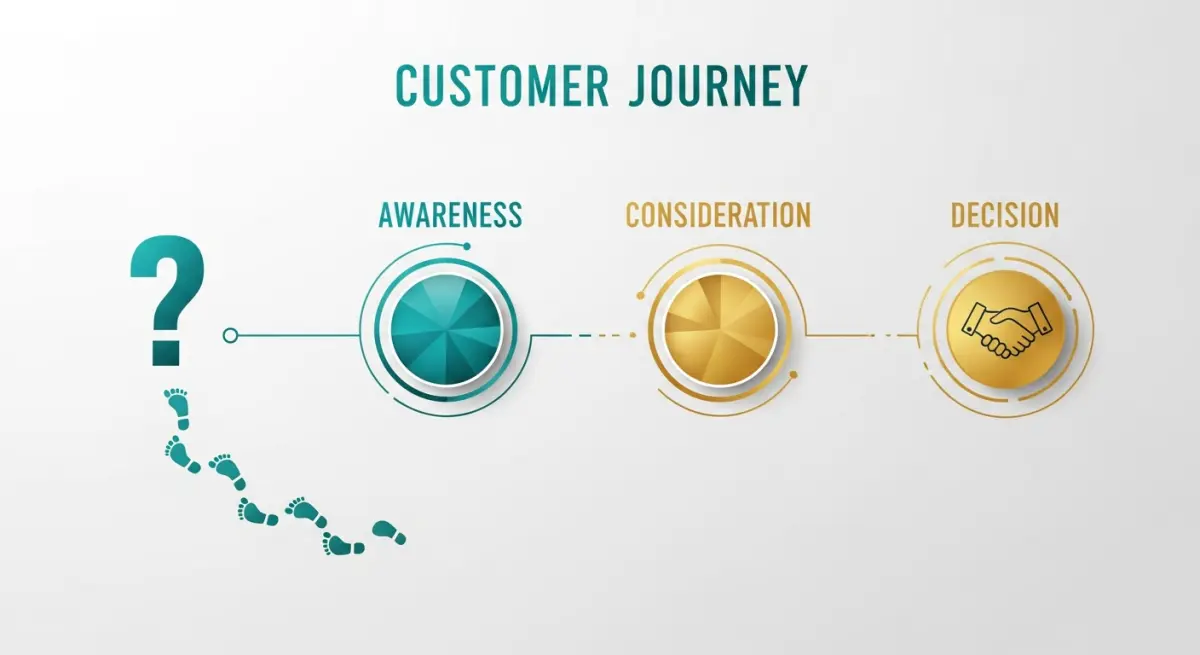
Nobody wakes up and decides to hire an SEO consultant. Or a plumber. Or a wedding photographer. There's always a series of events, searches, conversations, and mental shifts that happen first. The businesses that understand this sequence and show up at each step with the right message are the ones that win the client. The ones that only show up at the end with "hire me" miss everyone who isn't ready yet.
The pattern is remarkably consistent across industries, even when the specifics vary. Knowing this pattern changes how you think about your entire marketing strategy.
This post is part of my Marketing Playbook series.
Five stages every customer passes through
Stage 1: Unaware
The person has a problem but hasn't connected it to a solution. Sometimes they don't even realize the problem exists.
Imagine a landscaping company owner watching leads dry up over two seasons. He blames the economy, the weather, the neighborhood. What he does not realize is that three competitors who moved into his area all have optimized websites and active Google profiles, while his site has not been updated since 2020.
What your marketing should do here: Create content that helps people see the problem clearly. Articles like "Why Most Business Websites Fail" reach people in this stage and help them understand what's actually going on.
Stage 2: Problem aware
The person knows something is wrong and starts looking for explanations. They're researching, not shopping.
The landscaping company owner starts Googling things like "why am I losing customers to competitors" and discovers concepts like local SEO, Google Business Profile, and the importance of online reviews. He is learning. He is not ready to buy anything.
What your marketing should do here: Provide educational content that explains solutions honestly. Blog posts should answer questions thoroughly and build trust without pushing a sale. People at this stage are wary of being pitched. Generosity wins.
Stage 3: Solution aware
The person understands what needs to happen and is figuring out who can do it, or whether they should handle it themselves.
The landscaping company owner knows he needs SEO help. He starts evaluating options: doing it himself, hiring a freelancer, working with a local agency. He reads comparison articles, checks credentials, looks at portfolios.
What your marketing should do here: Prove competence. Your About page, testimonials, case studies with real numbers, and transparent explanations of your process all serve this moment. This is where credibility separates you from competitors.
Stage 4: Decision
Two or three options remain. The person is looking for the tipping point that makes one stand out.
What your marketing should do here: Eliminate friction. A clear value proposition, visible social proof, straightforward pricing information, and an obvious way to get started. Your calls to action need to be unmissable. Make saying yes effortless.
Stage 5: Retention and referral
They hired you. Now the focus shifts to delivering results, maintaining the relationship, and turning this client into a source of referrals and reviews.
What your marketing should do here: Deliver on every promise. Communicate proactively. Send clear reports showing results. Make it easy for happy clients to tell other people about you.
How to map your specific customer journey
Every business attracts customers through a slightly different path. Here's my process for mapping it.
Step 1: Talk to your best customers
Ask them directly:
- How did you first realize you needed this service?
- What did you search for or ask about?
- What other options did you consider before reaching out to me?
- What made you choose me over the alternatives?
- What almost stopped you from contacting me?
Their answers reveal things your marketing data never will.
Step 2: List every touchpoint
Where does a potential customer encounter your business during their journey?
- Google search results
- Your website
- Google Business Profile
- Review sites
- Social media profiles
- Referrals from friends, neighbors, or colleagues
Step 3: Spot where people disappear
Where in the journey do potential customers fall out? Common problem areas:
- No content for the unaware stage. People with the problem can't find you because you haven't written about it.
- No proof for the solution aware stage. People evaluating you can't find evidence that you deliver.
- Too much friction at the decision stage. People ready to hire can't easily figure out the next step.
Step 4: Fill each gap
Create content, fix touchpoints, and remove barriers wherever prospects are dropping off. Each gap filled converts more strangers into clients.
Connecting the journey to your marketing channels
Content strategy
Your content library should cover every stage:
- Unaware: "Signs your website is costing you customers"
- Problem aware: "How local SEO works for Denver businesses"
- Solution aware: "How to choose between DIY and professional marketing"
- Decision: Testimonials, case studies, transparent About page
SEO keyword targeting
Different stages produce different search queries:
- Unaware: "why am I not getting new customers"
- Problem aware: "how to get more website traffic"
- Solution aware: "SEO consultant Denver"
- Decision: "best SEO agency Denver reviews"
If you only target decision-stage keywords, you're competing for 20 percent of the market and ignoring the other 80 percent.
Email marketing
Email nurtures subscribers through the stages over time:
- First emails: educational content (meeting them at problem aware)
- Middle emails: case studies and proof (guiding them to solution aware)
- Later emails: clear call to action (helping them decide)
Trust accumulates at every stage
The businesses that win clients aren't always the most talented at their craft. They're the most skilled at building trust throughout the entire path from stranger to customer.
Unaware stage trust. The prospect doesn't know you exist. Trust starts forming through the quality and helpfulness of your content. A blog post that accurately describes someone's problem and offers practical guidance without a sales pitch attached creates the first deposit. Giving without expecting anything builds a foundation.
Problem aware stage trust. The person is actively researching and reading from multiple sources. Trust signals here include consistent information across your blog, schema markup that validates expertise, and author trust signals showing a real person with verifiable credentials is behind the words.
Solution aware stage trust. Social proof becomes decisive. The person is comparing providers and looking for concrete evidence. Video testimonials, case studies with measurable outcomes, and a genuine about page move someone from "interested" to "convinced."
Decision stage trust. The final step is often the simplest, and it's where plenty of businesses fumble. A professional website, visible phone number and address, fast response to inquiries, and a clear explanation of what happens after they say yes. Broken contact forms, slow replies, or confusing next steps undermine everything you've built up to this point.
Post-purchase trust. After the sale, trust is sustained through follow-through. Regular performance reports showing exactly what is being done and what it produces convert clients into advocates who send referrals without being asked. Transparency is the foundation of retention.
How AI is reshaping the journey
The traditional journey is getting reorganized. When someone asks ChatGPT or Claude "who should I hire for SEO in Denver?" they skip multiple stages and arrive at a decision point almost instantly.
That has practical implications:
Shortcut paths exist now. A customer might jump from completely unaware to decision-ready based on a single AI recommendation. Your business needs to show up in AI responses, not just traditional search results.
The path is less predictable. Someone might start with a voice query on their smart speaker, follow up with a ChatGPT question, verify on Google, check Reddit for opinions, then visit your website. Being present across all these touchpoints matters more than ever.
Trust signals cross platforms. AI models piece together their picture of your business from your website, reviews, Reddit mentions, social profiles, and directory listings. Trust built in one place influences how you're represented everywhere. Consistent messaging across sources matters enormously.
First-party content anchors your AI presence. The content you control directly, your website, your blog, your Google Business Profile, becomes the raw material AI uses to represent you. Strong, accurate first-party content gives AI something reliable to work with.
Journey mapping mistakes I see regularly
Only creating decision-stage content. Most businesses build service pages, pricing information, and contact forms. All decision-stage stuff. That's fine, but it addresses maybe 20 percent of potential customers. The other 80 percent, who aren't ready to hire yet, find nothing useful and leave. Content for earlier stages dramatically expands your addressable audience.
Assuming one journey covers everyone. A homeowner needing a kitchen renovation and a property manager sourcing maintenance contractors follow completely different paths, even when both need the same type of work. Mapping separate journeys for distinct customer segments and building targeted content for each dramatically improves conversion rates.
Ignoring what happens after the sale. Retaining a customer costs a fraction of acquiring a new one. Referrals convert at the highest rate of any lead source. Yet most businesses invest almost nothing in post-purchase engagement. A simple follow-up email sequence, a review request system, and a referral program can shift the economics of your entire operation.
Not measuring where people drop off. If you don't know where prospects abandon the journey, you can't patch the leaks. Google Analytics shows which pages people exit from. Heatmaps reveal what people do and don't interact with on those pages. That data tells you exactly where to focus.
Pulling it together
Understanding the customer journey transforms random marketing activities into a connected system. Every blog post, every website page, every email serves a specific purpose in moving someone from "never heard of you" to "loyal client who tells their friends."
Without a mapped customer journey, you create content that misses people at the exact moment they need to hear from you, and those prospects go to whoever shows up first.
Picture every piece of your marketing working together, meeting potential clients exactly where they are and guiding them naturally from stranger to customer.
If you're not sure where your customer journey breaks down, let's talk. I'll map the path for your business and show you where to focus.
Frequently asked questions
How long does it take for a customer to decide to hire a service business?
It varies enormously by service type and price point, ranging from a few days to two months or more. For a straightforward, lower-cost service like house cleaning, the journey might last a few days. For higher-investment services like SEO, web design, or home renovation, I typically see two to eight weeks from first awareness to hiring.
Higher cost and higher perceived risk stretch the timeline. This is why trust-building at every stage matters so much. You need to stay top of mind throughout what can be a lengthy evaluation process.
How do I attract customers who don't know they need my service yet?
Write about symptoms, not solutions. Instead of "why you need SEO," write about "why your phone isn't ringing" or "why your competitor always appears first on Google."
People in the unaware stage experience the symptoms of their problem without connecting them to the cause. Your content bridges that gap by drawing the line between what they're feeling and the solution you provide.
Do I need separate landing pages for each stage of the buyer journey?
Not necessarily separate pages, but your website should speak to each stage through different types of content. Blog content typically serves the unaware and problem-aware stages. Service pages handle the solution-aware stage. Testimonials, case studies, and your about page serve the decision stage.
The key is that someone at any point in the journey can find relevant content without digging for it. Clear navigation and internal linking between stages guide visitors through naturally.
How can I tell what stage my website visitors are in?
Check your Google Search Console data, because the queries people use to find your site reveal their stage. Informational queries like "what is local SEO" indicate problem-aware visitors. Comparison queries like "SEO agency vs freelancer" signal solution-aware visitors.
Brand searches and queries including "reviews" indicate decision-stage visitors. Analyzing the distribution shows where your traffic concentrates and whether you need more content for underrepresented stages.
Want me to help with your SEO?
I help small businesses get found on Google. Let me show you what I can do for yours.
Let's talk