How to Read Your Website Traffic Report
Website traffic reports can be overwhelming. I break down what the numbers actually mean and which ones matter for your Denver business, no technical.
Key Takeaways
- •Not all website traffic is valuable, and what matters is whether it comes from potential customers
- •Organic search traffic from Google is the highest-value source for most local businesses
- •A sudden traffic spike isn't always good, so check whether the visitors are in your target market
- •Low traffic with high conversions is better than high traffic with zero conversions
- •Understanding where traffic comes from helps you decide where to invest your marketing time
Do you know what your website visitors actually did last month? Not how many of them showed up, but what they did once they arrived? Most business owners open Google Analytics, stare at a number, feel either encouraged or worried, and close the tab. That number, on its own, tells you almost nothing.
Imagine a landscaping company seeing traffic triple in six weeks. Sounds great until you check the source: nearly all of it came from a Pinterest pin about rock garden design. The company installs sprinkler systems and mows lawns. Those Pinterest visitors bounced because they wanted inspiration boards, not irrigation quotes.
Meanwhile, 200 people per month found the site through searches like "lawn care service Arvada" and "sprinkler repair near me." Those 200 visitors were calling the office. The Pinterest traffic was noise. The Google traffic was revenue.
This post is part of my Analytics series.
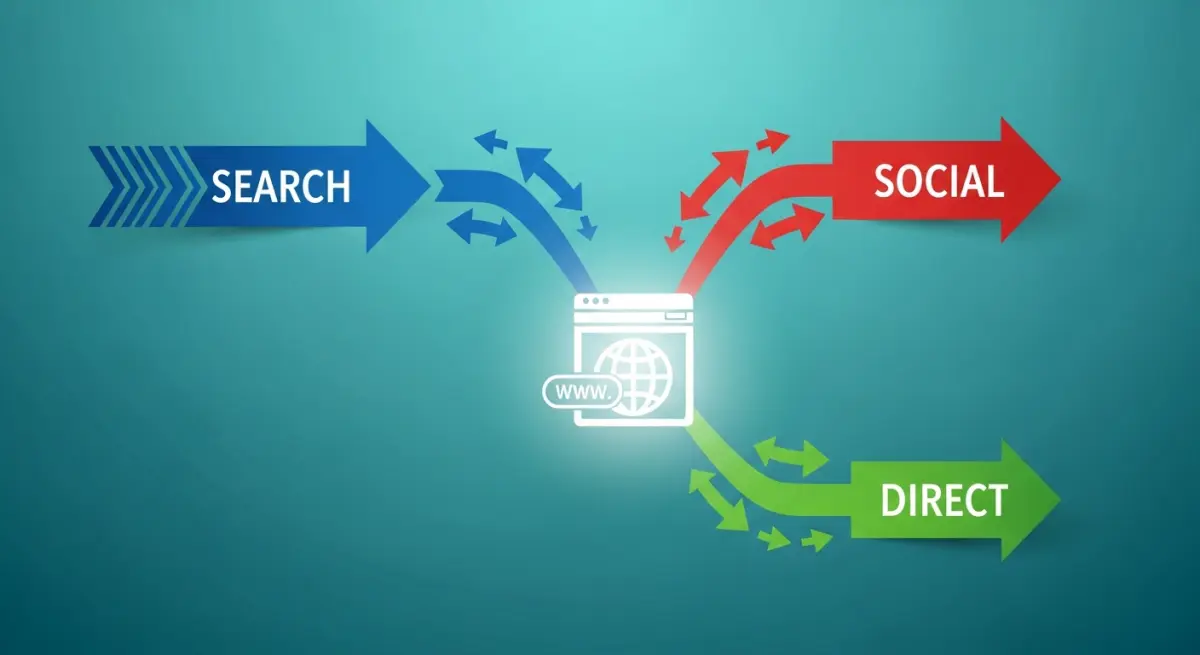
Where does website traffic come from?
Organic search traffic
This is the traffic that arrives when someone types a query into Google and clicks on your listing. For most service businesses in Denver, organic search is the highest-quality traffic source because these people are actively looking for something you provide.
Organic traffic is the core metric when measuring SEO ROI. If it grows steadily over time, your search presence is expanding.
Direct traffic
Someone types your URL directly into their browser, or they click a bookmark they saved earlier. Direct traffic means that person already knows your business exists. They picked up your card, a friend mentioned your name, or they remembered your company from a previous visit.
Strong direct traffic usually reflects healthy brand recognition in your local market.
Referral traffic
These visitors clicked a link on someone else's website to get to yours. That might be a local news site, a chamber of commerce page, a partner's blog, or a directory listing.
Referral data reveals which backlinks bring actual people, not just link equity.
Social traffic
Visitors who arrived from Facebook, LinkedIn, Instagram, or similar platforms. For most local businesses, social traffic is a small slice of the overall pie. It has its place, but if you are trying to decide where your time goes, I have a post comparing email vs. social media that breaks it down honestly.
Paid traffic
Anyone who arrived through an ad, whether that is Google Ads, Facebook Ads, or something else. If you are running paid campaigns alongside SEO, separating the two in your reports is critical. You need to understand what organic effort produces on its own.
What separates valuable traffic from noise
Geographic relevance
If you serve the Denver metro, traffic from Denver, Littleton, Thornton, and Centennial is the traffic that matters. Global traffic looks impressive on a dashboard but does nothing for your bottom line unless you sell products nationwide. Google Analytics shows exactly where your visitors are located.
Service relevance
Visitors who search for terms directly related to your services are the ones worth paying attention to. Someone landing on your HVAC site because they searched "furnace repair Denver" has a reason to hire you. Someone arriving because you ranked for "how does a furnace work" might be a curious homeowner with no buying intent at all.
Conversion behavior
The ultimate test is action. Does the visitor call, fill out a form, request a quote, or schedule a consultation? Tracking conversion rates by traffic source reveals which channels produce customers, not just eyeballs.
Reading common traffic patterns
Steady upward trend
This is what healthy growth looks like. Your SEO efforts are building on each other. More pages indexed, more keywords ranking, more people finding you.
A sharp spike followed by a drop
Something got shared widely, maybe a blog post hit the front page of a subreddit, or a local influencer linked to you. Exciting in the moment, but check whether those visitors match your audience. If they are from outside your service area or searching for something unrelated, the spike won't produce business.
Gradual decline over weeks
This needs investigation. Possible causes include a Google algorithm update affecting your rankings, technical issues blocking crawlers, competitors gaining ground, or content that has gone stale. Don't wait months to look into it.
Seasonal swings
Perfectly normal for many industries. Roofing companies in Denver see spikes after hailstorms. Tax preparers get surges in February and March. Wedding venues peak in spring. Knowing your seasonal pattern prevents panic during predictable slow periods.
Flatlined traffic
Not declining but not growing either. Usually a sign that you have stopped publishing new content, stopped earning backlinks, or stopped targeting new keywords. Growth requires ongoing effort.
Metrics that seem important but often mislead
Bounce rate
A bounce is a visit where someone viewed one page and left. Sounds terrible, right? But think about this: if a person searches "Denver plumber phone number," lands on your contact page, and calls you, that is technically a bounce. It is also a conversion. High bounce rates on contact and location pages are often perfectly fine.
Time on page
Longer is not inherently better. If someone gets their answer in 20 seconds and picks up the phone, that is a win. Time on page without context is meaningless.
Total page views
More pages per session could mean deep engagement. Or it could mean confusion, a visitor clicking around trying to find basic information that should have been obvious.
The numbers that actually tell you something
- Organic traffic from your service area (are the right people finding you?)
- Conversion rate (form fills, calls, quote requests)
- Traffic trend over time (growing, flat, or shrinking)
- Top landing pages (which content attracts the most visitors)
- Keywords driving visits (via Search Console)
A practical five-minute monthly review
You do not need to become an analytics expert. Five minutes each month gives you everything you need.
- Users overview (30 seconds): Compare this month to last month. Up, down, or flat? That is your headline.
- Traffic sources (1 minute): Open the Acquisition section. See the split between organic, direct, referral, and social. Notice any big changes.
- Top pages (1 minute): Which pages got the most visits? Are those the pages that actually drive business, or random content that attracts tire-kickers?
- Location data (1 minute): Where are your visitors located? For Denver businesses, you want to see Denver, Aurora, Lakewood, Boulder, and neighboring cities. Heavy traffic from overseas is usually irrelevant.
- Conversions (1.5 minutes): How many meaningful actions happened? Form submissions, phone calls, appointment bookings. This is the number that connects to revenue.
If anything looks off, a sudden traffic drop, a strange referral source, a conversion rate change, that is when you dig in or reach out for help.
Custom dashboards save time
Simple dashboards that display only the metrics you care about save enormous time:
- Monthly organic traffic trend (line chart)
- Top 10 landing pages
- Traffic by city (filtered to Colorado)
- Conversions by source
- Mobile vs. desktop split
Google Analytics 4 makes this straightforward under the Explore section.
Warning signs that demand attention
A sudden drop of 20 percent or more
Small fluctuations happen. But a 20 percent drop in a single week usually points to a real problem:
- A Google algorithm update hit your rankings
- A technical issue is blocking Google from accessing your pages
- Your SSL certificate expired and browsers are showing security warnings
- A competitor launched an aggressive campaign targeting your top keywords
Check Google Search Console first. It reveals most issues within a day or two.
Traffic growing but zero conversions
If more people visit but nobody contacts you, something in the experience is broken. Either you are attracting the wrong audience (check keywords and geography), your pages are not persuasive enough (review your call to action strategy), or your contact forms are literally malfunctioning. Test them yourself right now. Seriously.
Suspicious bot traffic
Not all traffic is human. Bot traffic inflates your numbers and makes your reports unreliable. Signs include:
- Session durations of zero seconds across a large batch of visits
- 100 percent bounce rate from a single source
- Traffic surges from countries with zero connection to your business
- Referrals from domains you have never heard of
Filter known bots in your Analytics settings and use event tracking to separate genuine interactions from automated crawling.
Using traffic data to make better decisions
Invest more in what works
If a blog post about "how to choose a wedding photographer in Denver" drives 35 percent of your organic traffic, write more content around that topic. "Questions to ask your wedding photographer," "average wedding photography costs in Colorado," "indoor vs outdoor wedding photo tips." The data is telling you what your audience wants. Follow it.
Fix pages that attract visitors but lose them
A service page with decent traffic, high bounce rate, and zero conversions needs work on the page itself, not more visitors. Sharpen the headline, add testimonials, and make the next step impossible to miss. Doubling conversions on an existing page produces the same result as doubling traffic, with far less effort.
Find keyword gaps
Compare what keywords currently drive traffic (visible in Search Console) with the keywords you wish you ranked for. The gap between those two lists is your content to-do list. If you want to rank for "mobile pet grooming Highlands Ranch" but that phrase does not appear in your data, you probably need a dedicated page with solid on-page optimization.
Spend your budget where the data points
If organic search produces 75 percent of your conversions but gets 20 percent of your marketing budget, something is backwards. Traffic source data helps you allocate marketing dollars toward what actually generates results.
Frequently asked questions
How many website visitors do I need to get leads?
There is no magic number because conversion rate and traffic quality matter more than raw volume. Some businesses pull ten leads per month from 300 visitors while others need 3,000 visitors to match that.
A physical therapy clinic getting 150 monthly visitors from people searching "physical therapy near me" will generate far more appointments than a site getting 5,000 visitors from generic fitness searches. Nail the quality first, then scale the volume.
Why did my website traffic drop after a Google update?
Small fluctuations of 5 to 10 percent are normal, but drops beyond 20 percent lasting more than two weeks need real investigation. Check Search Console for manual actions or security flags. Look at which pages and keywords lost visibility.
The solution typically involves strengthening content depth, improving E E A T signals, or fixing technical issues the update began flagging.
What is a good conversion rate for a business website?
For local service businesses, 2 to 5 percent is a healthy conversion rate. That means two to five out of every hundred visitors take a meaningful action like calling or filling out a form. Emergency services sometimes reach 8 to 10 percent. Professional services and consulting often sit between 1 and 2 percent.
If you are under 1 percent, focus on improving landing pages, simplifying your contact process, and adding social proof before pouring more money into driving traffic.
How do I track phone calls from my website as conversions?
Use a dedicated tracking number that only appears on your website. Tools like CallRail or Google's call forwarding in Google Ads assign a unique number to your site. When someone dials it, the system logs the call as a conversion and records which page the visitor was on.
For service businesses where phone calls are the primary action, this is essential. Without call tracking, you are probably underreporting your website's actual conversion rate by 30 to 50 percent.
Without understanding what your traffic data actually means, you keep investing in channels that look busy but produce nothing while ignoring the ones quietly generating your best leads.
Imagine opening your analytics dashboard and knowing within five minutes exactly what is working, what needs attention, and where your next customers are coming from.
If your traffic data feels confusing, let's talk. I will translate the numbers into a clear picture of what is working and what needs attention.
Want me to help with your SEO?
I help small businesses get found on Google. Let me show you what I can do for yours.
Let's talk